
Pecos County Court Records After Arrest
The arrest-to-court path in Pecos County follows the Texas distinction between jail custody records and court case records. A booking record shows the custody event and the arrest allegations known at intake. Court records show what the prosecutor files and what the court does with the case. Those two records can differ. A charge can be declined, amended, reduced, dismissed, indicted under different wording, or resolved by plea or trial.
For the custody side, use Pecos County jail inmate records and the sheriff/jail line. For booking photos, use the separate Pecos County jail mugshot process. For court records after a jail arrest, start with the clerk or court that handles the offense level. Felony and district-court files route through the District Clerk. County-level records may route through the County Clerk. Fort Stockton Class C, fine-only, ordinance, and animal-control cases route through Municipal Court.
Search Court Records After Jail Arrest
A Pecos County court records after arrest search works best when the custody fact, court, and case number are tied together. The Pecos County District Clerk page lists Darla Cude at 400 S. Nelson St. in Fort Stockton with phone (432) 336-3503. The County Clerk page lists Liz Chapman at 200 S. Nelson St., Suite 3, with phone (432) 336-7555. The Fort Stockton Municipal Court page lists city court contacts for fine-only and ordinance cases.
- Confirm the booking and arresting agency with the Pecos County sheriff or jail if custody is still in question.
- Ask which court handled the first appearance and whether a cause number, warrant number, or case number has been assigned.
- Contact the District Clerk for felony or district-court criminal records, or the County Clerk for records handled by that office.
- For Fort Stockton Class C or ordinance cases, check Fort Stockton Municipal Court rather than the county jail.
- Use re:SearchTX as a statewide case-search aid, then verify any match with the local clerk because portal coverage may be incomplete.
- Use Texas DPS criminal history only for statewide criminal-history searches, not as a substitute for a full court file.
The re:SearchTX court-record portal may help locate records where a court participates and the record is available for the user's access level.
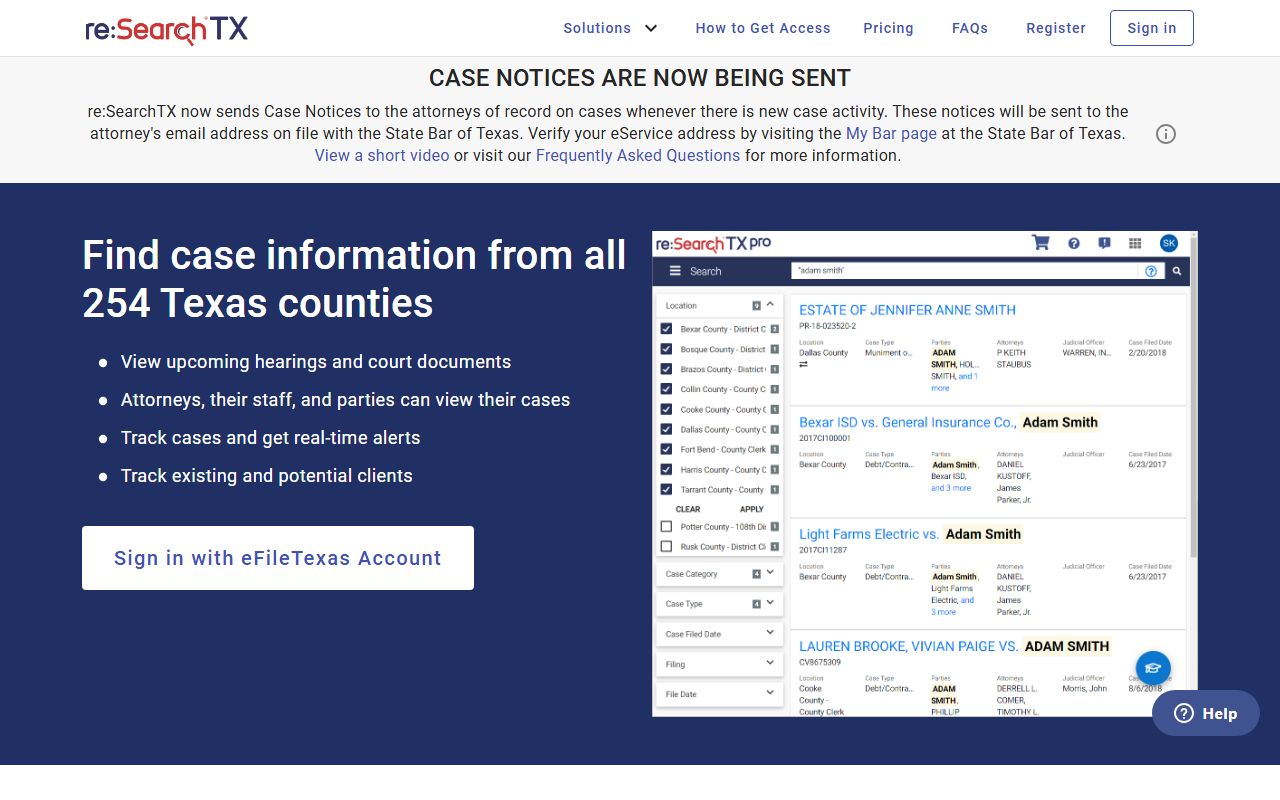
The statewide portal should be treated as a search aid, not a complete replacement for Pecos County clerk verification.
Pecos County Arrest Charging Records
After a Pecos County arrest, Texas law requires a prompt magistrate warning under Code of Criminal Procedure Article 15.17. That first appearance does not prove the final charge. Prosecutors decide what to file. Pecos County has official pages for the 83rd District Attorney, the 112th District Attorney, and the County Attorney. Depending on offense and court, the charging record may be a complaint, information, or indictment.
| Document | Who Uses It | What It Means |
|---|---|---|
| Complaint | Officer, complainant, or prosecutor path | A sworn allegation or charging document used to begin some Texas criminal proceedings. |
| Information | Prosecutor | A prosecutor-filed charging paper often used for non-indicted offenses. |
| Indictment | Grand jury | A grand-jury charging document used for felony prosecution. |
Pecos County Charge Status
Charge status can change after a jail arrest. The jail may first list an arrest allegation or warrant language. The prosecutor may later file a different charge, add a count, reduce a charge, or dismiss a count. A case can also move from complaint to indictment. Court records after arrest should therefore be read by status and date, not by the first booking text alone.
| Status | What It Means |
|---|---|
| Pending | The charge or case has not reached final disposition. |
| Filed | The prosecutor has submitted formal charge paperwork. |
| Indicted | A grand jury returned a felony charging document. |
| Amended | The charge wording changed after filing. |
| Reduced | The charge was lowered to a lesser offense. |
| Dismissed | The court or prosecutor ended that charge without a conviction. |
| Deferred adjudication | A Texas supervision outcome that may avoid final conviction if completed. |
Bond After Pecos County Arrest
Bond records connect the jail side and the court side. Texas Code of Criminal Procedure Chapter 17, including Article 17.15, governs bail. Bail must be high enough to give reasonable assurance that the person appears, but it may not be used as an instrument of oppression. The court considers the offense, ability to make bail, safety, criminal history, and other statutory factors.
| Bond Type | How It Works in a Records Search |
|---|---|
| Cash bond | Money is posted with the proper jail or court authority. Pecos payment methods were not posted online. |
| Surety bond | A licensed bail bond company posts surety, subject to jail and court acceptance. |
| Personal bond or PR bond | The court releases the person on promise and conditions without a full cash deposit. |
| No-bond hold | Release is blocked until the hold clears or a court acts. |
| Detainer | Another agency requests custody or notice and may affect release timing. |
Pecos County did not post bond-payment hours, payment methods, card fees, cashier's check rules, or an online bond portal. Call the sheriff/jail line at (432) 336-3521 and ask for the bond amount, bond type, court, cause number, and any holds before trying to post bond.
Pecos County Arrest Warrants
No official Pecos County sheriff active-warrant search, downloadable warrant list, or most-wanted page was located. For county warrants, the official path is to contact the sheriff, the court, or the clerk tied to the case. Fort Stockton's emergency and non-emergency guidance says tickets, warrants, and court dates are non-emergency matters and gives the police non-emergency number as (432) 336-4600.
A warrant can create both a jail record and a later court record. Arrest warrants authorize an arrest for a suspected offense. Bench warrants are issued by a judge, often after failure to appear. Capias and capias pro fine writs can lead to arrest or enforcement in Texas court matters. A fugitive or out-of-county warrant may create a hold even if a Pecos County bond appears to be set.
Texas Code of Criminal Procedure Article 15.26 treats an executed arrest warrant and supporting affidavit as public information under its terms. That public-access rule does not mean Pecos County has an online warrant list.
Pecos County Charges vs Convictions
Being arrested or charged is not the same as being convicted. A charge is an accusation in the court record. A conviction is a final result after a plea, verdict, or judgment. Public court records after arrest can show both, but the status and disposition fields must be read carefully.
| Point | Charge | Conviction |
|---|---|---|
| Stage | Accusation or filed count | Final guilt finding or plea with judgment |
| Proof level | Based on probable cause or charging decision | Based on plea, verdict, or adjudication standard |
| Record effect | May remain pending, be amended, or be dismissed | May affect sentence, supervision, and criminal history |
Pecos County Sealed Arrest Records
Texas uses expunction and nondisclosure for different record-clearing outcomes. Code of Criminal Procedure Chapter 55A covers expunction procedures for eligible arrest records. Government Code Chapter 411 includes nondisclosure provisions. Eligibility depends on the charge, disposition, timing, and court order.
| Point | Sealed or Nondisclosed | Expunged |
|---|---|---|
| Public view | Hidden from most public access | Removed or treated as though it did not exist under the order |
| Government access | Some agencies may still have lawful access | Access is much more limited after expunction |
| Texas route | Usually tied to nondisclosure law and court order | Usually tied to Chapter 55A eligibility and court order |
Restricted Pecos County Court Records
Not every record tied to an arrest is public online. Juvenile matters, sealed cases, certain dismissed matters, protected personal details, and active investigations may be restricted. Law-enforcement exceptions may apply to some records, but Texas Government Code Section 552.108(c) protects basic information about an arrested person, arrest, or crime from being withheld under that specific exception.
For statewide criminal-history purposes, Texas DPS provides a criminal-history search channel, and DPS notes that paid search credits are used for searches. That is not the same as a complete Pecos County court file. A court file can include filings, docket entries, charge changes, bond orders, judgments, and dismissal orders that do not appear the same way in a name-based history search.
Important: A public court search is not an FCRA consumer report and should not be used for employment, tenant, credit, or insurance screening.